
Recycling Plant for EV Lithium Battery: Process, Equipment and Environmental Benefits
With the rapid growth of electric vehicles (EVs), the number of used lithium-ion batteries is increasing worldwide. recycling plant for EV lithium battery can recover valuable materials from end-of-life EV battery packs while reducing waste and supporting a circular battery supply chain. Modern recycling systems combine safe battery handling, mechanical separation, and further metal recovery to turn waste batteries into reusable resources.
What Type of Battery Is Used in EVs?
Most electric vehicles use rechargeable lithium-ion batteries (LIBs) because of their high energy density, long cycle life, and relatively high power output. EV lithium batteries can have different cathode chemistries, including:
- NMC (Nickel Manganese Cobalt) – widely used where high energy density is required.
- NCA (Nickel Cobalt Aluminum) – another nickel-based chemistry used in EV applications.
- LFP (Lithium Iron Phosphate) – increasingly common because of its thermal stability, long cycle life, and reduced reliance on nickel and cobalt.
- LMO (Lithium Manganese Oxide) – used in some lithium-ion battery applications.
The battery may be supplied in cylindrical, prismatic, or pouch cell formats. An EV battery pack normally consists of numerous cells assembled into modules and packs.
What Valuable Materials Can Be Recovered?
An EV lithium-ion battery contains several recyclable materials. Depending on the battery chemistry and design, a recycling plant can recover:
- Lithium – commonly recovered from cathode materials and black mass.
- Nickel – particularly valuable in NMC and NCA batteries.
- Cobalt – present in several nickel-based cathode chemistries.
- Manganese – mainly found in NMC and LMO materials.
- Graphite – commonly used as the anode material.
- Copper – mainly from current-collector foil and electrical connections.
- Aluminum – found in cathode current collectors, housings, and structural components.
- Iron and steel – commonly recovered from battery casings and structural parts.
- Plastic and separator materials – can be separated as additional fractions.
The exact material composition varies considerably between battery chemistries.
How to Build an EV Lithium Battery Recycling Plant?
Before building a recycling plant for EV lithium battery, operators should determine the feedstock, processing capacity, target products, battery chemistries, safety requirements, and local environmental regulations.
A basic plant can be divided into the following sections:
- Battery receiving and safe storage: Inspect, classify, and isolate damaged or potentially hazardous batteries.
- Discharging and dismantling: Safely discharge batteries where required and remove packs, modules, wiring, casings, and other external components.
- Shredding: Reduce battery modules or cells into smaller particles under controlled conditions.
- Screening and separation: Separate different particle sizes and recover ferrous, non-ferrous, plastic, and electrode-rich fractions.
- Black mass collection: Collect the fine mixture containing cathode and anode materials.
- Further refining: Process black mass using hydrometallurgy, pyrometallurgy, or other suitable technologies to recover battery-grade materials.
Mechanical pretreatment can produce copper-rich, aluminum-containing, plastic, graphite, and cathode-material fractions before additional refining.
Main Machines for an EV Lithium Battery Recycling Plant
A complete EV lithium battery recycling plant may include:
- Battery discharge equipment
- Pack/module dismantling equipment
- Conveyor systems
- Lithium battery shredder or crusher
- Granulator or milling machine
- Vibrating or rotary screening machine
- Magnetic separator
- Eddy current or other non-ferrous separation equipment
- Air classifier
- Dust collection and filtration system
- Black mass collection system
- Hydrometallurgical refining equipment, when high-purity metal recovery is required
The exact configuration should be customized according to battery chemistry, capacity, cell format, and the required purity of the final products. Battery recycling also requires appropriate fire protection, ventilation, monitoring, containment, and safe storage because damaged lithium-ion batteries can present fire and chemical hazards.
EV Lithium Battery Recycling Process
A typical process can be summarized as:
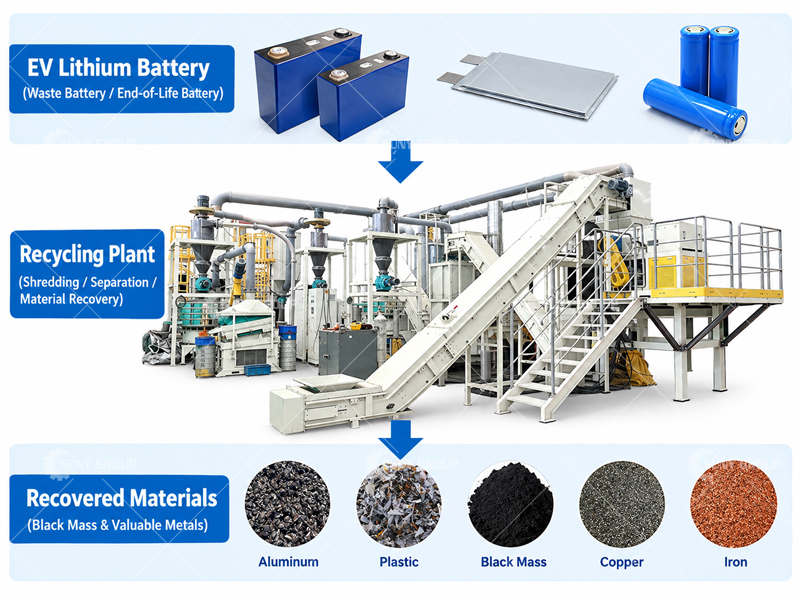
Waste EV Battery → Inspection → Discharging → Dismantling → Shredding → Crushing/Granulation → Screening → Magnetic & Air Separation → Black Mass → Metal Refining → Recovered Materials
The mechanical stage primarily separates physical components and produces black mass. The black mass can then undergo hydrometallurgical treatment to recover lithium, nickel, cobalt, manganese, and other valuable materials.
Why Is EV Lithium Battery Recycling Important?
Recycling EV batteries helps recover critical minerals and reduces dependence on newly mined raw materials. The recovered materials can potentially return to battery and industrial supply chains, supporting a more circular economy. The IEA notes that end-of-life EV and energy-storage batteries are expected to become an increasingly important recycling feedstock as the installed battery fleet grows.
From an environmental perspective, recycling can reduce the need for primary extraction of lithium, nickel, cobalt, copper, and other materials. It also helps divert end-of-life batteries from inappropriate disposal and provides controlled treatment for materials that require specialized handling.
For these reasons, a properly designed recycling plant for EV lithium battery can combine resource recovery, waste reduction, environmental protection, and circular-material production into one integrated recycling solution.