
Mini Copper Wire Cable Separator Machine
The increasing volume of waste electrical and electronic equipment has created a growing supply of scrap copper wires and cables. These materials contain valuable copper covered by plastic or rubber insulation. Instead of selling mixed cable scrap at a lower value, recyclers can use a Mini Copper Wire Cable Separator Machine to separate copper from insulation and produce clean, reusable materials. Small cable recycling machines are especially suitable for small recycling businesses, workshops, and companies with limited scrap volumes. Some compact models are designed for approximately 100–150 kg/h of cable processing, depending on the machine configuration and feed material.
1. What Is the Recycling Value of Waste Copper Wire and Cable?
Waste copper wire and cable have significant recycling value because copper is an important non-ferrous metal with excellent electrical and thermal conductivity. Scrap cables can come from:
- Waste electrical appliances
- Automobile wiring harnesses
- Computers and communication equipment
- Construction and power cables
- Industrial electrical equipment
- Telecommunication cables
- Household electrical wires
- Motorcycles and automotive electrical systems
The actual value of cable scrap depends largely on the copper content, wire diameter, insulation type, cleanliness, and local copper market price. For example, recent Japanese scrap listings show that copper-wire scrap with higher copper content commands substantially higher prices than lower-copper mixed wire.
This makes efficient copper-plastic separation an important way to increase the value of waste cable.
2. Why Choose a Mini Copper Wire Cable Separator Machine?
A Mini Copper Wire Cable Separator Machine is designed for businesses that do not require a large industrial cable recycling line.
Its main advantages include:
- Compact design: Requires less floor space than large recycling systems.
- Lower initial investment: Suitable for small and medium recycling businesses.
- Flexible capacity: Many small models process around 100–150 kg/h, while other configurations can reach higher capacities.
- Easy operation: Integrated machines can combine crushing and separation functions.
- Dry processing: Copper and plastic can be separated mechanically without water or chemical treatment.
- Low labor requirements: Automated feeding, separation, and collection reduce manual sorting.
- Good recovery efficiency: Properly configured equipment can produce high-purity copper granules.
- Easy maintenance: Compact structures generally simplify inspection and routine maintenance.
For a new recycling business, a mini machine can therefore provide a practical entry point without requiring the space and investment associated with a large cable recycling plant.
3. How Does a Mini Copper Wire Cable Separator Machine Work?
The working principle is mainly based on crushing, granulation, screening, airflow separation, and differences in material density.
Step 1: Feeding
Waste copper cables are placed into the feeding hopper. The feedstock should be selected according to the machine’s allowable wire diameter and material type.
Step 2: Crushing and Granulation
The machine cuts and crushes the cables into small particles. During this process, the copper conductor is liberated from the surrounding PVC, PE, or rubber insulation.
Step 3: Air Separation
The crushed mixture enters an air-separation system. Because copper is much denser than plastic, controlled airflow can separate the heavier copper particles from lighter plastic particles.
Step 4: Fine Separation
For thin wires or fine particles, an electrostatic separator can be added to improve the separation of residual copper and plastic. This technology uses the different electrical conductivity characteristics of metal and non-metal materials.
Step 5: Collection
The separated copper granules and plastic particles are discharged through different outlets and collected separately.
The basic process can therefore be summarized as:
Waste Cable → Crushing → Granulation → Air Separation → Fine Separation → Copper + Plastic
4. What Materials Does the Machine Produce?
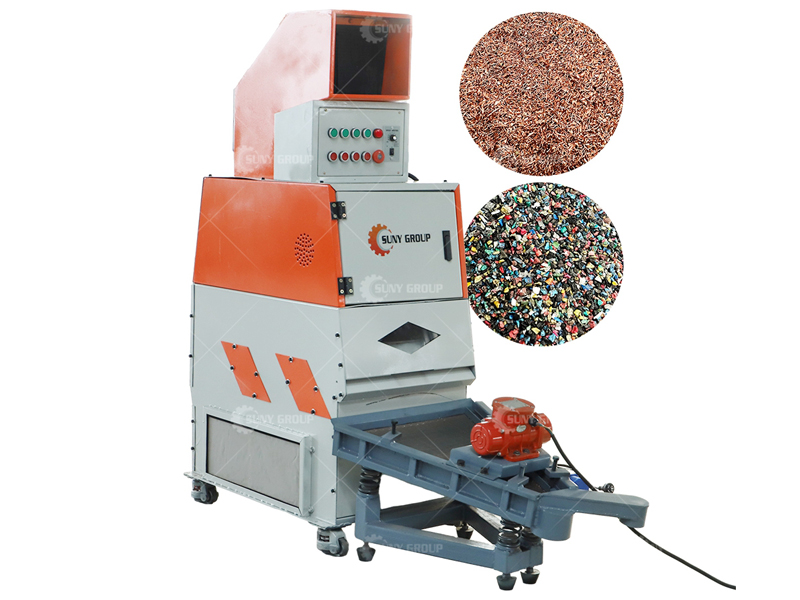
The main outputs of a Mini Copper Wire Cable Separator Machine are copper granules and plastic granules.
Copper Granules
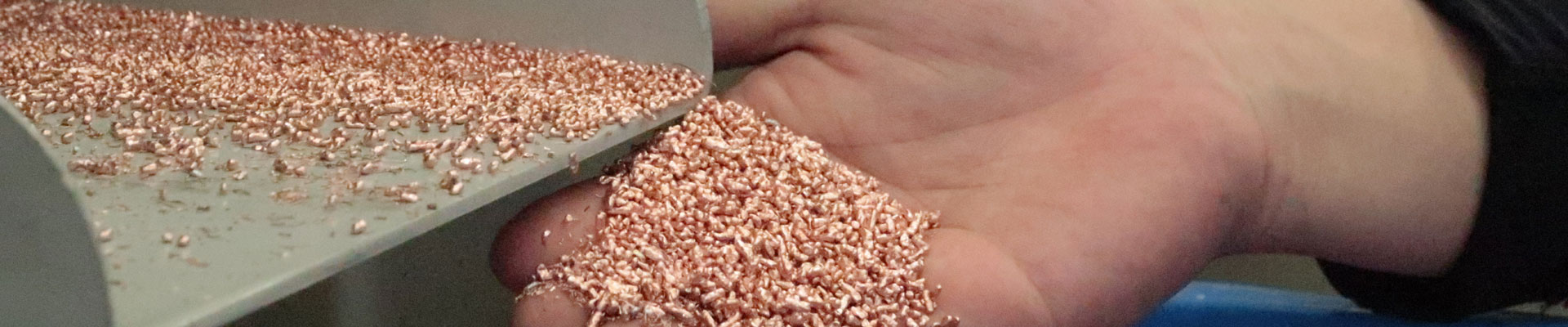
The recovered copper normally has a granular or “copper rice” appearance. Depending on the feedstock and machine configuration, the copper can achieve high separation purity. Some commercial systems report separation rates around 99%, although actual performance should always be verified through material testing.
Plastic Granules
The second major product is separated plastic insulation, commonly PVC or rubber depending on the original cable. These materials can be sold to plastic recyclers or further processed into recycled plastic products.
5. What Are the Uses of Recovered Copper and Plastic?
Recovered copper has a wide range of applications because it retains substantial material value. It can be supplied to metal recyclers, smelters, and copper-processing companies for further refining and manufacturing.
Recycled copper can ultimately be used in:
- Electrical cables
- Wires and connectors
- Motors and transformers
- Electrical equipment
- Construction products
- Copper alloys
- Industrial components
The separated plastic can also be processed into recycled plastic products, depending on its polymer type and purity.
Importantly, clean separation increases the commercial value of both fractions compared with mixed cable scrap.
6. How to Choose a Mini Copper Wire Cable Separator Machine?
Before purchasing a Mini Copper Wire Cable Separator Machine, buyers should evaluate:
- Required processing capacity
- Cable diameter and feed size
- Copper content of the raw material
- Copper recovery and separation purity
- Air-separation technology
- Optional electrostatic separation
- Dust collection system
- Power consumption
- Ease of maintenance
- Spare parts and after-sales service
The best machine should be selected according to the actual cable feedstock rather than capacity alone. A professional manufacturer should ideally conduct a sample test before recommending the final machine configuration.
The Mini Copper Wire Cable Separator Machine provides an efficient solution for recovering valuable copper from waste electrical wires and cables. By using crushing, granulation, airflow separation, and optional electrostatic separation, the machine can separate copper from PVC, PE, or rubber insulation without conventional manual stripping.
For small recycling businesses, its compact size, relatively low investment, simple operation, flexible capacity, and valuable copper output make it an attractive recycling solution. The recovered copper can enter electrical and metal-processing industries, while separated plastic can be further recycled into new products. Choosing the right machine according to cable type, diameter, capacity, recovery purity, and manufacturer support is the key to building a reliable and profitable cable recycling operation.