
E-Waste PCB Dismantling and Recycling Line
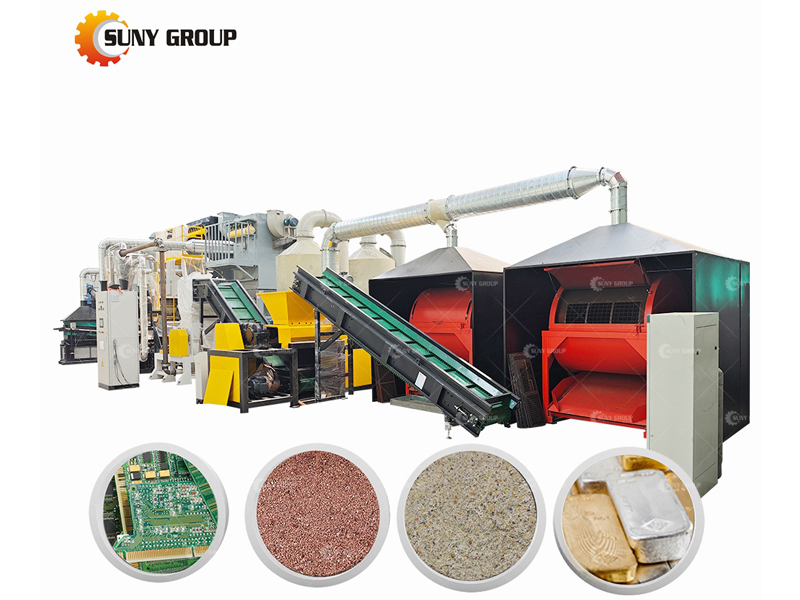
With the rapid development of electronics, computers, communication equipment, and consumer appliances, discarded electronic products are increasing worldwide. An e-waste PCB dismantling and recycling line provides an efficient way to dismantle electronic waste, recover printed circuit boards (PCBs), and separate valuable metals and other reusable materials. A properly designed recycling system can reduce waste while creating a reliable source of secondary raw materials.
1. What Is E-Waste?
E-waste refers to discarded electrical and electronic equipment and their components. Common e-waste includes:
- Waste computers and laptops
- Mobile phones and communication equipment
- Televisions and monitors
- Printers and photocopiers
- Servers and power supplies
- Household electrical appliances
- Waste cables and wires
- Motors, transformers, and electronic components
- Waste printed circuit boards
Among these materials, waste PCBs are an important recyclable fraction because they contain copper and smaller quantities of valuable metals such as gold, silver, and palladium. Therefore, separating PCBs from mixed e-waste is an important step in improving resource recovery.
2. What Is an E-Waste PCB Dismantling Machine?
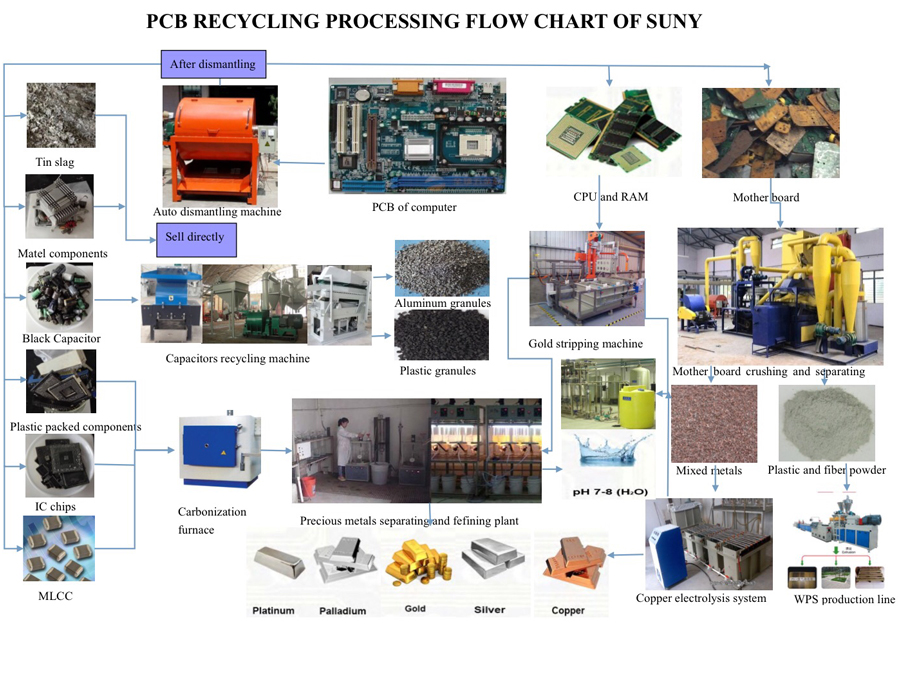
An e-waste PCB dismantling machine is designed to remove valuable electronic components and PCBs from discarded electrical equipment efficiently. Depending on the type of e-waste, the dismantling section can include manual dismantling stations, conveyors, electric screwdrivers, cutting tools, cable stripping machines, and specialized PCB dismantling equipment.
The process generally starts with dismantling the outer housing and removing batteries, cables, PCBs, motors, transformers, and other components. For PCB recycling, specialized heating or component-removal equipment can help separate electronic components from circuit boards before further processing.
For larger volumes, the dismantling section can be connected with shredding and separation equipment to create a continuous e-waste PCB recycling line.
3. How to Build an E-Waste PCB Recycling Line?
The configuration of an e-waste recycling plant should be selected according to the material type, capacity, PCB content, required product purity, and local environmental requirements.
A typical process includes:
- Feeding and sorting: Workers or conveyors classify different types of e-waste.
- Pre-dismantling: Remove batteries, cables, housings, motors, and other special components.
- PCB collection: Separate waste PCBs from the electronic equipment.
- Primary crushing: A suitable shredder reduces the size of PCB-rich materials.
- Fine crushing: A crusher or pulverizer further liberates metals from resin and fiberglass.
- Magnetic separation: Ferrous metals are removed from the crushed material.
- Eddy current or other separation: Non-ferrous metals can be separated from lighter fractions.
- Air separation and screening: Plastics, fiberglass, and metal-rich particles are classified.
- Downstream metal recovery: PCB-rich fractions can be sent to suitable refining or metallurgical processes.
The complete line can be customized for different capacities, from small recycling workshops to large industrial plants.
4. What Materials Can Be Recovered?
A well-designed e-waste PCB dismantling and recycling line can produce several useful material streams, including:
- Copper: From PCBs, cables, connectors, and other electrical components.
- Aluminum: From heat sinks, housings, and electronic components.
- Iron and steel: From frames, screws, brackets, and other structural parts.
- Precious-metal-bearing PCB fractions: PCBs may contain gold, silver, palladium, and other valuable metals.
- Plastics: Recovered from electronic housings and insulation.
- Electronic components: Certain components can be separately collected for further processing.
- Glass and other non-metallic materials: Depending on the incoming e-waste.
The final product quality depends heavily on dismantling efficiency, crushing particle size, separation technology, and the composition of the original e-waste.
5. Economic Value of E-Waste PCB Recycling
The economic value of an e-waste PCB recycling plant comes mainly from recovering valuable metals and recyclable materials while reducing disposal requirements. PCB-rich waste can be particularly attractive because copper and precious-metal-bearing fractions may have considerably higher material value than ordinary mixed waste.
However, profitability cannot be determined simply from the market price of copper or gold. Important factors include:
- E-waste purchase cost
- PCB content and metal composition
- Processing capacity
- Recovery rate and product purity
- Equipment investment
- Electricity and labor consumption
- Maintenance costs
- Environmental-control requirements
- Local prices for recovered materials
Therefore, investors should conduct a material composition test and economic feasibility analysis before selecting equipment.
6. Why Choose an E-Waste PCB Recycling Line?
An integrated e-waste PCB dismantling and recycling line combines dismantling, crushing, screening, and separation into an organized recycling process. Compared with simple manual dismantling, mechanized processing can improve throughput and make material separation more consistent.
More importantly, PCB recycling helps recover secondary resources from discarded electronics and reduces the quantity of valuable metals lost through disposal. For businesses handling large quantities of obsolete electronic equipment, building a customized PCB recycling system can provide both resource-recovery and waste-management benefits.
E-waste PCB dismantling and recycling line is an effective solution for processing waste computers, phones, appliances, communication equipment, cables, and other electronic products. By combining pre-dismantling, PCB separation, shredding, crushing, magnetic separation, screening, and downstream metal recovery, the plant can produce copper, aluminum, iron, plastics, and valuable PCB-rich fractions. Selecting the right equipment according to the feedstock and processing capacity is the key to establishing an efficient and economically viable e-waste recycling plant.