
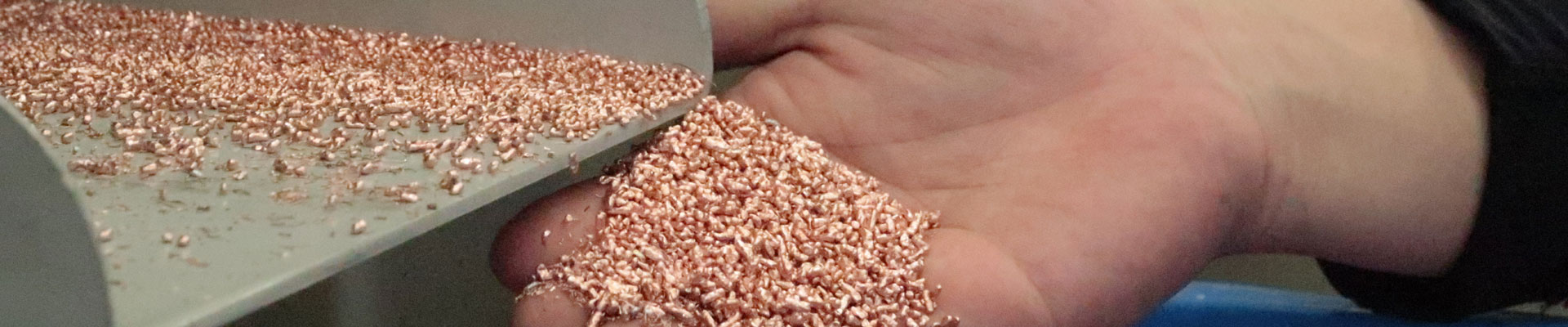
Circuit Board Recycling Machine for Recovery of Copper
Waste printed circuit boards (PCBs) are one of the most valuable components of electronic waste. They are widely found in discarded computers, mobile phones, televisions, printers, communication equipment, household appliances, automobiles, and industrial electronic devices. Unlike ordinary plastic waste, circuit boards contain a mixture of valuable metals and non-metallic materials, making them suitable for professional recycling.
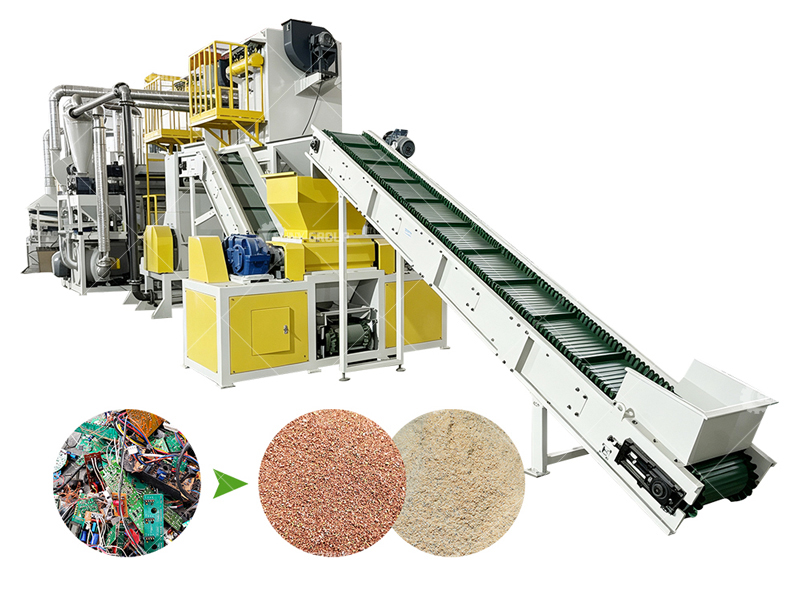
A circuit board recycling machine for recovery of copper can separate copper and other valuable metals from fiberglass, epoxy resin and plastics through a combination of shredding, crushing, screening and physical separation. Recent research also emphasizes mechanical pretreatment as an important step before further copper recovery.
Where Do Waste Circuit Boards Come From?
Waste circuit boards mainly come from:
- Computers and servers – motherboards, graphics cards and control boards.
- Mobile phones and tablets – compact, high-value PCBs.
- Televisions and monitors – power boards and control boards.
- Printers and office equipment – control and interface boards.
- Household appliances – washing machines, refrigerators and air conditioners.
- Automotive electronics – engine control units and other electronic modules.
- Communication equipment – routers, switches and telecommunications devices.
- Industrial equipment – PLC control boards and electronic controllers.
The composition varies considerably depending on the source, age and design of the PCB. Therefore, testing the raw material before selecting a PCB recycling machine is highly recommended.
How Much Copper Is in a Circuit Board?
Copper is generally one of the most important recoverable metals in waste PCBs, but its exact content is not fixed. One published study found approximately 19.19% copper in a particular waste-PCB sample, while the total metal content was about 39%. The same sample contained aluminum, nickel, iron, tin and lead in addition to copper.
Other studies have reported even higher copper concentrations in certain conductive fractions after mechanical processing. In one investigation, the copper content of some concentrated conductive fractions exceeded 50% by mass.
Therefore, for a commercial project, customers should not simply assume that every PCB contains the same percentage of copper. Raw-material analysis is the basis for accurate equipment selection, recovery calculations and investment estimates.
How Is Copper Recovered from Circuit Boards?
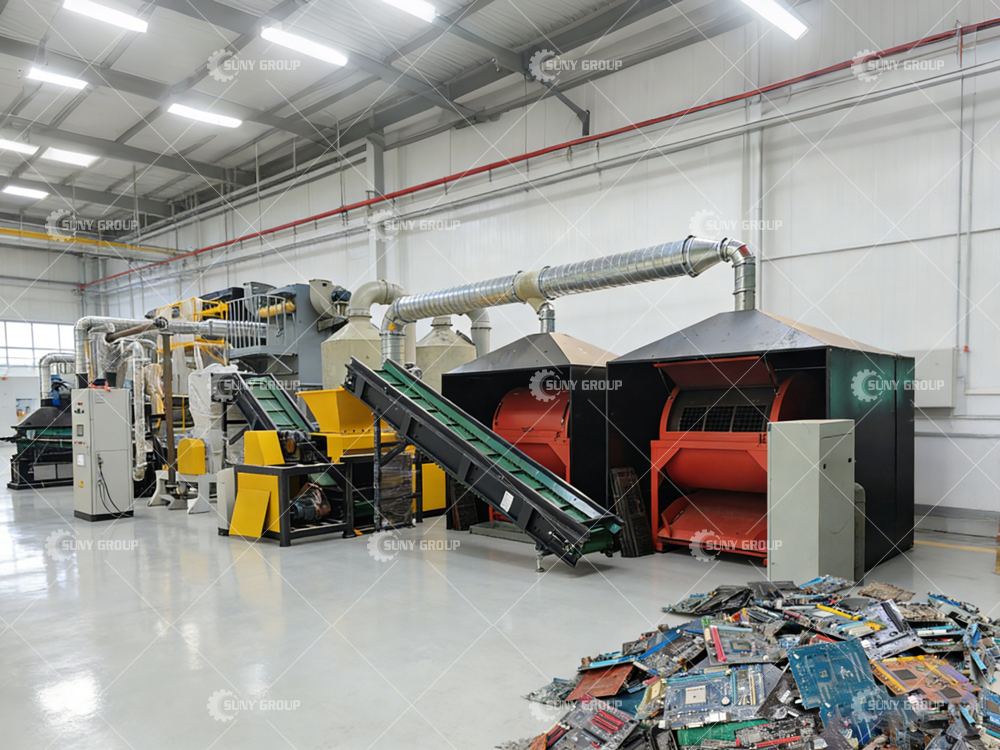
A typical mechanical PCB recycling process can be divided into several stages:
Waste PCB → Dismantling → Shredding → Crushing → Screening → Magnetic Separation → Air/Gravity Separation → Electrostatic Separation → Copper-Rich Product
1. Dismantling
Large components, batteries, cables and other unsuitable materials are removed from the waste circuit boards. This improves safety and protects downstream equipment.
2. Shredding
A PCB shredder reduces large circuit boards into smaller pieces. Proper size reduction makes subsequent separation more efficient.
3. Crushing and Grinding
The shredded material enters a crusher or mill for further size reduction. The purpose is to liberate copper particles from fiberglass and resin. Research has shown that mechanical comminution and classification can effectively expose and enrich metallic components.
4. Screening
A vibrating screen classifies the crushed material according to particle size. This allows different fractions to be processed under appropriate separation conditions.
5. Magnetic Separation
A magnetic separator removes iron, nickel and other magnetic materials. This reduces impurities in the non-magnetic fraction containing copper and other non-ferrous metals.
6. Gravity, Air or Electrostatic Separation
Light fiberglass and resin can be separated from heavier metallic particles using air or gravity separation. Electrostatic separation can then improve the separation of conductive metals from non-conductive materials. Mechanical recycling research identifies comminution, air classification, gravity, magnetic and electrostatic separation as important PCB recycling technologies.
What Machines Are Needed for a PCB Recycling Plant?
A standard circuit board recycling machine for recovery of copper may include:
- Feeding conveyor – continuously feeds PCB material.
- Dismantling table – removes unsuitable components.
- Primary PCB shredder – reduces the size of whole boards.
- Secondary crusher or hammer mill – liberates metal particles.
- Vibrating screen – controls particle size.
- Magnetic separator – removes ferrous metals.
- Air separator or gravity separator – separates light non-metallic materials.
- Electrostatic separator – improves copper/non-metal separation.
- Dust collection system – controls dust generated during crushing.
- Conveyors and electrical control system – connect and automate the production line.
The exact equipment combination should be determined according to the PCB type, capacity and required copper purity.
How to Configure a Circuit Board Recycling Plant?
For a typical mechanical copper recovery plant, the process can be configured as:
Feeding → Primary Shredding → Secondary Crushing → Screening → Magnetic Separation → Air/Gravity Separation → Electrostatic Separation → Copper Collection
For example, if the raw material contains large amounts of ferrous components, a stronger magnetic separation stage may be required. If the PCB contains a high proportion of fine copper particles, the crushing and screening stages should be optimized to avoid excessive grinding and improve separation efficiency.
A research-scale mechanical process using milling, size classification, gravity separation and magnetic separation successfully enriched copper while separating iron and nickel.
For projects requiring high-purity copper, mechanical separation can be followed by hydrometallurgical or electrochemical refining. One study combining mechanical processing with electrometallurgy obtained copper deposits exceeding 98% purity, demonstrating the potential of mechanical pretreatment followed by further refining.
How to Choose a Circuit Board Recycling Machine Manufacturer?
When selecting a circuit board recycling machine manufacturer, consider:
- Raw-material testing capability
- Copper recovery rate
- Final copper product purity
- Processing capacity
- Machine wear resistance
- Dust-control system
- Energy consumption
- Automation level
- After-sales technical support
- Complete plant design and installation service
The manufacturer should ideally conduct a material test before recommending the final equipment configuration.
A circuit board recycling machine for recovery of copper provides an efficient way to recover valuable resources from electronic waste. Since waste PCBs contain copper together with aluminum, iron, nickel, tin, lead, fiberglass and resin, the recycling process normally requires several stages rather than a single machine.
For most mechanical PCB recycling projects, the basic configuration is shredding + crushing + screening + magnetic separation + gravity/air separation + electrostatic separation. If higher copper purity is required, additional refining technology can be added. The best plant configuration should always be based on PCB composition, feed size, processing capacity, target copper purity, recovery requirements and local environmental regulations.